NEW · Clinical Studies Software. Remote skin studies at scale. Explore –>


A moisturizer that works for your colleague might do nothing for your skin - or worse, trigger a breakout. Yet for decades, the beauty industry sold the same products to every skin type with the same three-line routine on the box.
Personalized skincare changes that equation. Instead of guessing, AI-powered platforms now analyze each individual's skin at a parameter level - detecting redness, pigmentation, pore size, skin tone, fine lines, and 35+ additional markers - match them to products proven to address exactly those concerns, and then go one step further: showing consumers a photorealistic simulation of what their own face will look like after using a specific product.
This guide explains how modern AI makes true personalization possible at each stage - analysis, recommendation, and visual proof - why the generic approach costs brands revenue, and what it takes to deploy all three at scale for tens of thousands of consumers.
The numbers are stark. According to research cited by Haut.AI's clinical team:
The disconnect is structural. Traditional skincare routines are built on archetypes - "dry skin," "oily skin," "combination" - but skin is far more complex than four categories can capture. Two people both classified as "combination skin" might have completely different concerns: one has enlarged pores and mild redness; the other has fine lines and uneven pigmentation. An AI model can tell them apart in under five seconds. A four-step quiz on a product page cannot.
The trust gap is equally damaging. When a brand says a serum reduces spots by 15%, a consumer has no way of knowing whether that claim applies to their skin - their undertone, their spot severity, their baseline. Abstract percentages don't translate into purchase confidence. The 74% who don't trust beauty claims aren't cynical; they've simply never seen proof that a product will work for them specifically.
The commercial cost is just as real. Shoppers who don't trust that a product is right for them don't add it to their cart. Brands that deploy AI-powered personalization - analysis, matched recommendations, and visual efficacy proof - consistently report average order value (AoV) uplift of 56% in US and European markets.
"Personalized skincare" has become a marketing buzzword attached to everything from a three-question quiz to a genetic test. Not all of it is equivalent. True AI personalization has four technical components working in sequence:
Personalization is only as good as the input data. If you don't know what a consumer's skin actually looks like - which specific concerns are present, how severe they are, which skin tone zone they fall into - any recommendation is still a guess.
Modern AI skin analysis, like Haut.AI's Face Analysis 3.0, analyzes facial skin from a single portrait photo across 40+ distinct parameters: breakouts, dark circles, eye puffiness, fine lines, deep lines, pigmentation subtypes (sun spots, melasma, freckles, moles), redness, pores, sagging, perceived age, skin tone, and more.
Critically, this is not a filter applied to a photo. It is a model trained on 3 million+ skin images, validated by dermatologists, and capable of detecting subtle distinctions that even trained clinicians can miss at a glance - like the difference between melasma and post-inflammatory hyperpigmentation, which require entirely different treatment protocols.
The analysis runs in under five seconds. The output is a structured skin profile that the recommendation engine can act on immediately.
The weakest link in most AI skin analysis deployments isn't the model - it's the input image. A blurry selfie taken in bad lighting produces unreliable data, no matter how sophisticated the model behind it.
Haut.AI addresses this with LIQA™ (Live Image Quality Assurance) - a smart camera layer that actively guides consumers to take analysis-ready photos. LIQA controls for lighting uniformity, face angle, distance, and motion blur in real time, displaying live feedback before the image is even captured. The result: consistent, clinically usable images at scale, without requiring consumers to follow technical instructions.
LIQA ships embedded in both Skin.Chat and AI Skin Analysis, and is available as a standalone web library for brands integrating via API.
A skin profile only creates value when it drives a product recommendation the consumer actually trusts. This is where most platforms fall short - they match skin concerns to product tags without weighing ingredient interactions, formulation suitability, consumer preferences, or real-time product availability.
Haut.AI's Deep C.A.R.E. (Context-Aware AI Recommendation Engine), launched in April 2025, approaches this differently. It combines advanced product tagging with comprehensive skin profiling, and - critically - it accepts free-text consumer refinements. A consumer who says "no retinol" or "fragrance-free only" will receive recommendations that honor those constraints, not just the highest-confidence skin match.
Deep C.A.R.E. also converts recommendation patterns into brand insights. When the engine consistently recommends third-party products because a brand's own catalogue doesn't cover a particular concern, that's flagged as a portfolio gap - turning the recommendation layer into a product development signal.
The final frontier of personalization is perhaps the most powerful: letting a consumer see what a product will actually do to their face before they buy.
Haut.AI's SkinGPT is a generative AI model that simulates skincare product effects on a consumer's real photograph - photorealistic, high-resolution, grounded in clinical trial data rather than generic filters. A brand uploads before/after data from their efficacy studies; SkinGPT extracts a custom simulation model specific to that product's measurable effects; any consumer's photo can then be processed to show exactly how their skin would respond to that product over time.
This directly addresses the trust gap at the point of purchase. The claim "spots reduced by 15%" becomes a side-by-side image of the consumer's own face - before and after treatment, at two weeks, four weeks, and eight weeks. Abstract marketing copy becomes personalized visual evidence.
Knowing the technology exists is one thing. Deploying it across a DTC website serving hundreds of thousands of visitors requires a production-grade implementation. Haut.AI offers four routes, depending on the brand's context and technical resources.
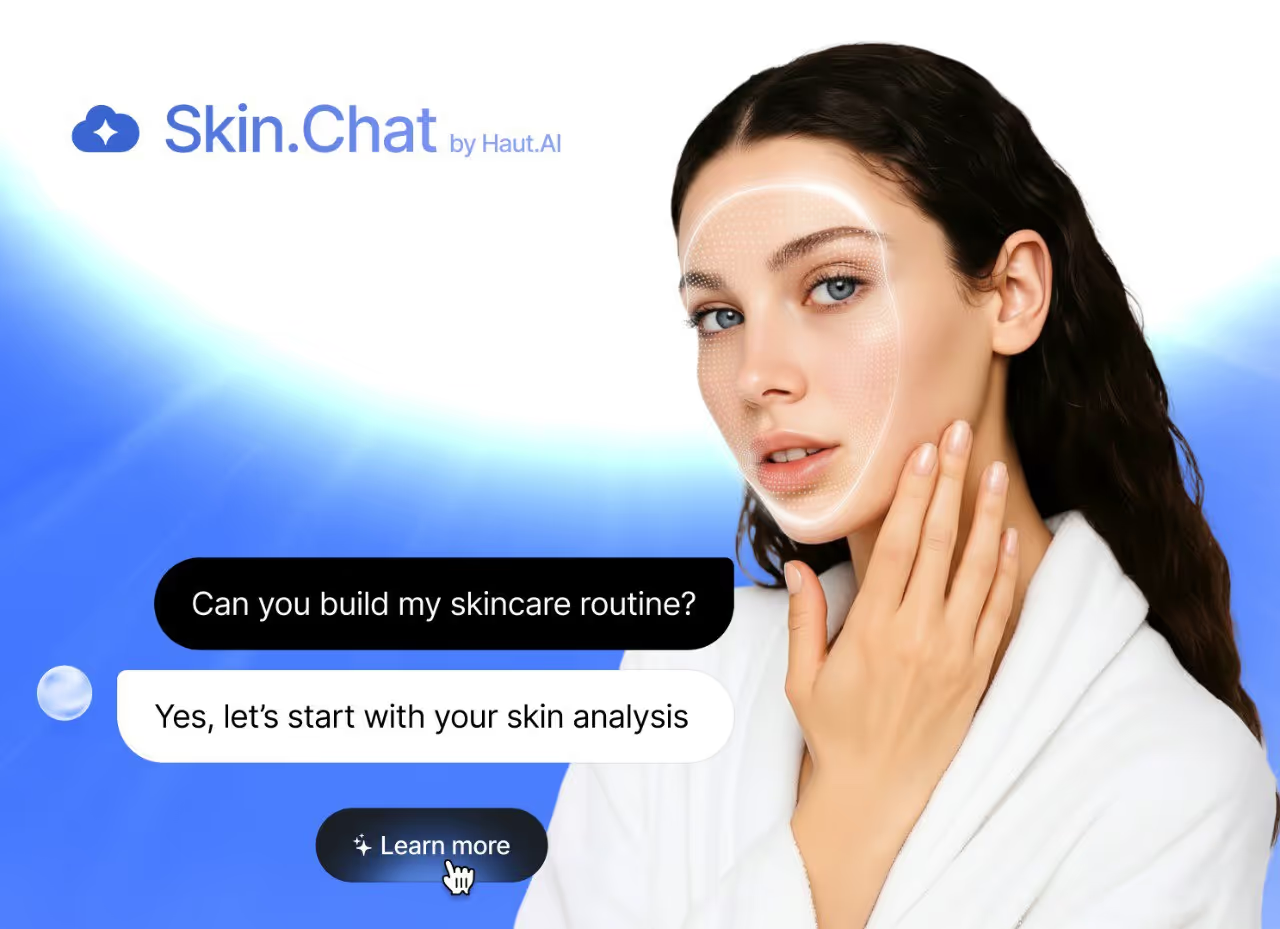
Skin.Chat is a ready-to-deploy AI chatbot widget that combines:
What distinguishes Skin.Chat from chatbots that simply surface marketing copy is the science layer underneath: the answers it gives are grounded in a dermatology knowledge base, and the products it recommends are matched to verified skin analysis output, not keyword associations.
For brands that want a structured, guided analysis flow rather than a conversational interface, the AI skin analysis delivers the same Face Analysis 3.0 analysis and Deep C.A.R.E. recommendations in a step-by-step widget format.
Proven in production across 50+ deployments:
AI Skin Analysis supports no-code customization (brand colors, logo, custom imagery), multi-language output, downloadable PDF skin analysis reports, and progress tracking across visits.
SkinGPT is where personalization becomes truly unprecedented: a consumer uploads their photo and sees a photorealistic, clinically-grounded simulation of their face after using a brand's specific product - at one week, two weeks, four weeks, and beyond.
Unlike cosmetic AR filters that apply generic overlays, SkinGPT builds a unique simulation model per product, extracted from the brand's own before/after clinical trial data:
Who uses SkinGPT:
On consumer deployment: SkinGPT currently operates via API - brands build their own consumer-facing experience on top of it. Once a product prompt is configured and attached to a dataset in the B2B portal, every new consumer image is automatically processed.
Accenture research found that 91% of consumers are more likely to shop with brands that provide relevant recommendations. PYMNTS data shows that 45% of millennials consider personalized offers very important to their purchase decisions.
Brands that invest in AI-powered personalization capture that preference through three compounding levers:
SkinGPT adds a fourth lever: claims credibility at the point of purchase. When 74% of consumers don't trust beauty claims, showing them a photorealistic simulation of their own face - derived from real clinical trial data - transforms scepticism into purchase confidence. The consumer is no longer weighing an abstract claim against past disappointments. They're looking at evidence.
Haut.AI's published model estimates that every $1 spent on customer acquisition, combined with the platform, generates a $3-equivalent consumer profile for hyper-personalized retargeting and a $1.50 AoV uplift in DTC sales.