NEW · Clinical Studies Software. Remote skin studies at scale. Explore –>


Most hair care personalization runs on self-report. A shopper picks "dry" or "fine" or "damaged" from a dropdown, answers four or five questions, and receives a routine assembled from those answers. The recommendation is only as good as the self-assessment underneath it. And people are not good at assessing their own hair. Anyone who has watched a consultation in person knows this. People misjudge texture. They describe hair as damaged when it is dry, or fine when it is simply flat. Lighting and mood shift the answer.
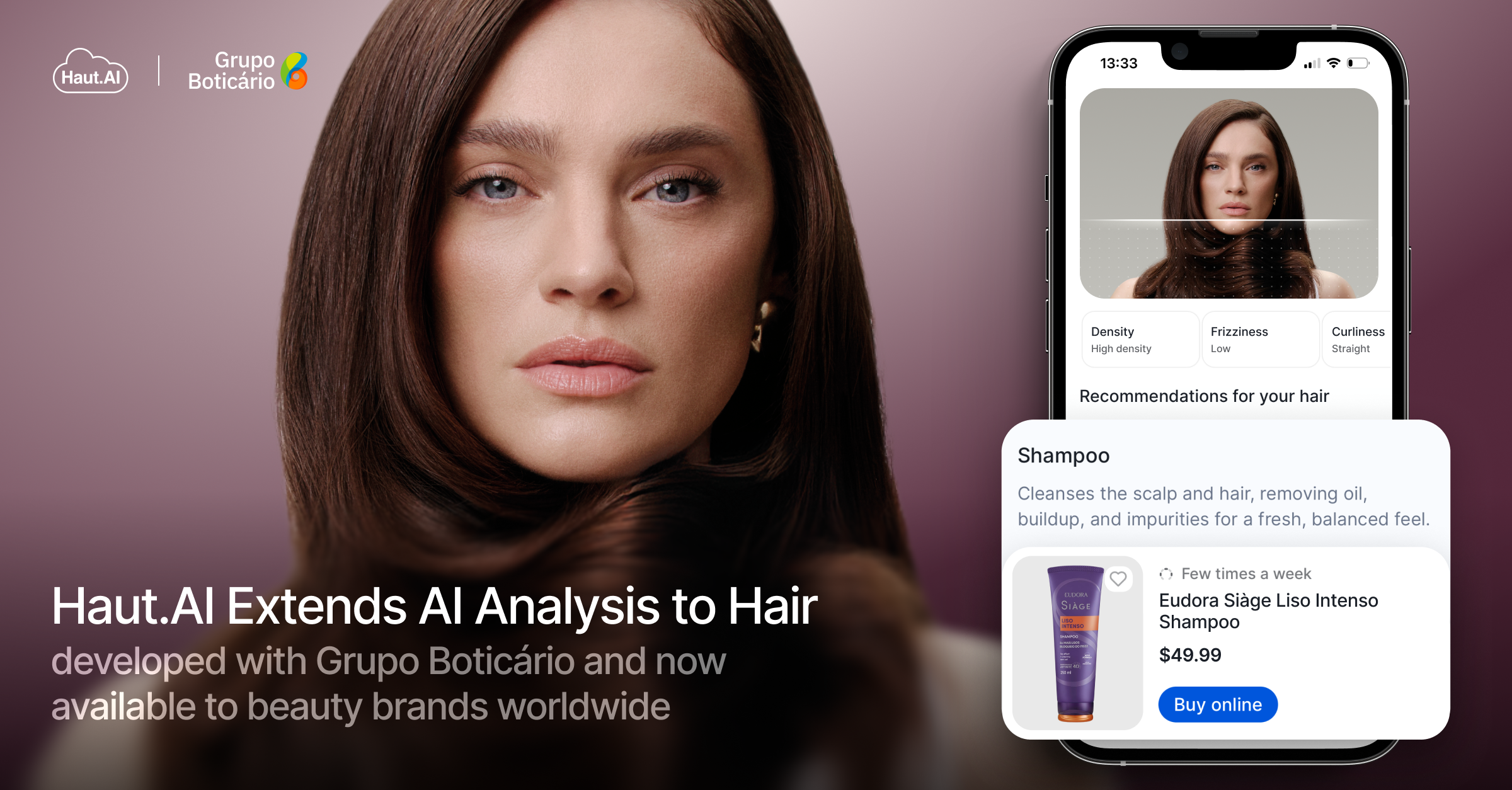
Today Haut.AI announced the commercial launch of Hair Analysis, a B2B technology that gives beauty brands and retailers a different starting point. Instead of asking a shopper to classify their own hair, it measures visible hair attributes from a single selfie, then combines that measurement with a short questionnaire covering the things a camera cannot see. The result is a hair profile built from two kinds of input, matched to products from the brand's own catalog.
"Haircare has faced a longstanding personalization challenge: hair is highly individual, yet product discovery still often relies on broad categories and trial and error," said Anastasia Georgievskaya, CEO & Co-Founder of Haut.AI. "Hair Analysis addresses that gap by combining visual assessment with consumer-provided insights to help brands connect people with more relevant products."
The distinction between measuring and asking matters more than it might sound. The problem in haircare isn’t that products do not work. It is that people frequently use the wrong ones, because the process that routes them to a product is guesswork wearing the interface of a diagnostic.
Hair Analysis evaluates six visible attributes from the image: curliness, volume, density, frizz level, color, and color uniformity. These are the characteristics a trained assessor would look at first, and they are the ones people are worst at judging in their own hair. Color uniformity, for instance, picks up uneven color and graying.
The questionnaire covers the rest. Hair length, styling and treatment habits such as heat styling, bleaching, coloring or perming, and the concerns the shopper actually cares about. A camera cannot know that someone flat-irons their hair four times a week or that their main frustration is split ends rather than volume. Together, the measured attributes and the self-reported context address 19 hair concerns, including dryness, frizz, split ends, lack of volume, chemical damage, and color-treated hair.
The capture itself is guided by LIQA™ (Live Image Quality Assurance™), Haut.AI's real-time image quality technology, which frames the shot and checks quality before the photo is submitted. This is the least glamorous part of the system and one of the most consequential. Measurement is only reproducible if the input is standardized. That's what makes it possible to compare one person's result to another's, or to their own result six weeks later. Capture works from a front camera, a back camera, or an uploaded image, on web or mobile. No app install, no in-store device, no salon visit.
The whole flow, from first tap to recommendations, takes under a minute.
A hair profile on its own is a report. What makes it commercially useful is what happens next.
The recommendation engine maps each profile to the brand's own catalog across 12 product categories, from shampoos and conditioners through treatments, masks, oils, and styling products. Brands tag their products against hair concerns inside the Haut.AI platform, and the engine surfaces each shopper's primary concern first. Results display either as a step by step routine or as a ranked product list, with a promotional slot and a "you may also like" block.
The recommendations do not come from a generic ingredient database or an industry-wide product index; they come from the catalog the brand actually sells, in the brand's own language. That means the output is a commerce surface, and it means a brand is not paying to route its own traffic toward someone else's assortment.
Behind the consumer experience sits the B2B toolkit, which is where most of the operational value accumulates over time.
Deployment is a shareable web link that runs in any browser, which means it can sit on a homepage, a product page, a campaign page, or an in-store kiosk without a development cycle attached to each placement.
Because the metrics are objective and the capture is standardized, the same person can be analyzed again later and the two results can be compared. That turns a one-off assessment into a longitudinal record, and a longitudinal record is what allows a brand to show whether a routine did anything.
This has a research application as well as a commercial one. Clinical hair studies rely on established methods such as phototrichogram, TrichoScan, and trichoscopy-based systems. These are accurate and they are resource-intensive, requiring specialist equipment, clinic-based capture, and expert review, which puts a ceiling on how many subjects a study can practically include. Haut.AI's technology supports standardized, higher-throughput hair data collection aligned with those methodologies, which makes measurement across larger populations more feasible. Haut.AI's algorithms are validated against clinical evaluation criteria, with methods published in peer-reviewed journals.
Hair Analysis was initially co-developed with Grupo Boticário, following the beauty company's strategic investment in Haut.AI. The collaboration paired Haut.AI's computer vision and personalization technology with Grupo Boticário's haircare science, consumer insight, and long experience of highly diverse hair needs. Grupo Boticário served as the launch partner, and the technology is now available to beauty brands and retailers worldwide.
"As an early partner in the development of Hair Analysis, we've seen firsthand how this technology can make haircare discovery intuitive for consumers," said Gustavo Dieamant, Executive Director of R&D at Grupo Boticário. "Hair needs are incredibly diverse, and Haut.AI has developed a solution that translates that complexity into an experience that helps consumers identify products suited to their individual needs. We're excited to see Haut.AI now bring this technology to beauty brands around the world."
Hair Analysis runs on the same platform and the same recommendation engine as Haut.AI's AI Skin Analysis. For brands already using Haut.AI for skin, adding hair is an extension of an existing integration rather than a second vendor, a second data flow, and a second set of consumer records to keep in sync.
With Hair Analysis joining Face Analysis 3.0 and Body Analysis, Haut.AI now covers face, body, and hair through one technology layer. For beauty groups, pharmacy chains, and retailers carrying broad portfolios, that coverage is the difference between three personalization experiences that each behave differently and one measurement layer that behaves consistently across digital and in-store channels.
The shift underneath all of this is not that hair care personalization is becoming more sophisticated. It is that it is becoming accountable. A recommendation grounded in what was measured can be checked, compared, and improved. A recommendation grounded in what a shopper guessed about themselves cannot.
See how it works. Try the live experience to walk through the consumer flow, or book a demo to see it running on your own catalog.
Hair care personalization is the process of matching individual consumers to hair products based on their specific hair characteristics and concerns rather than broad categories. Traditional approaches rely on quiz answers and self-reported hair type. AI-based approaches measure visible hair attributes from a photo and combine that measurement with self-reported context such as styling habits and concerns.
Hair quizzes depend entirely on how accurately a consumer describes their own hair, and self-assessment is subjective and inconsistent. People commonly misjudge texture, density, and condition, and their answers shift with lighting and mood. When the input is wrong, the recommendation built on it is wrong, regardless of how good the underlying product catalog is.
Haut.AI's Hair Analysis measures six visible hair attributes from a single selfie: curliness, volume, density, frizz level, color, and color uniformity. Color uniformity also picks up uneven color and graying. The analysis returns a structured hair profile that a brand's systems can act on.
A photo cannot capture behavior or intent. It cannot show how often someone heat-styles, bleaches, colors, or perms their hair, or which concern matters most to them. This is why Haut.AI's Hair Analysis pairs computer vision measurement with a short questionnaire covering hair length, styling and treatment habits, and primary concerns.
Brands upload and tag their own products against hair concerns inside the Haut.AI platform. The recommendation engine then maps each consumer's hair profile to those tagged products across 12 categories, surfacing the shopper's main concern first. Recommendations come from the brand's own catalog, not from a generic product database.
Yes. Because the capture is standardized and the metrics are objective, the same person can be analyzed again later and the results compared. This supports before and after comparison across a routine or product, and it turns a single assessment into a longitudinal record.
No hardware, no consumer app, and no in-store device. Hair Analysis is delivered as a shareable web link that runs in any browser, on a homepage, product page, campaign page, or in-store kiosk. The brand supplies a tagged product catalog; Haut.AI supplies the capture, measurement, and recommendation infrastructure.