SkinBench. How accurately do AI models measure skin? See the results –>


AI can recognize a face in a photo. That does not mean it can read the skin on it. When Haut.AI tested six leading AI models on SkinBench, a public skin analysis benchmark, the models reported eye puffiness in approximately 95% to 100% of images where it was absent.
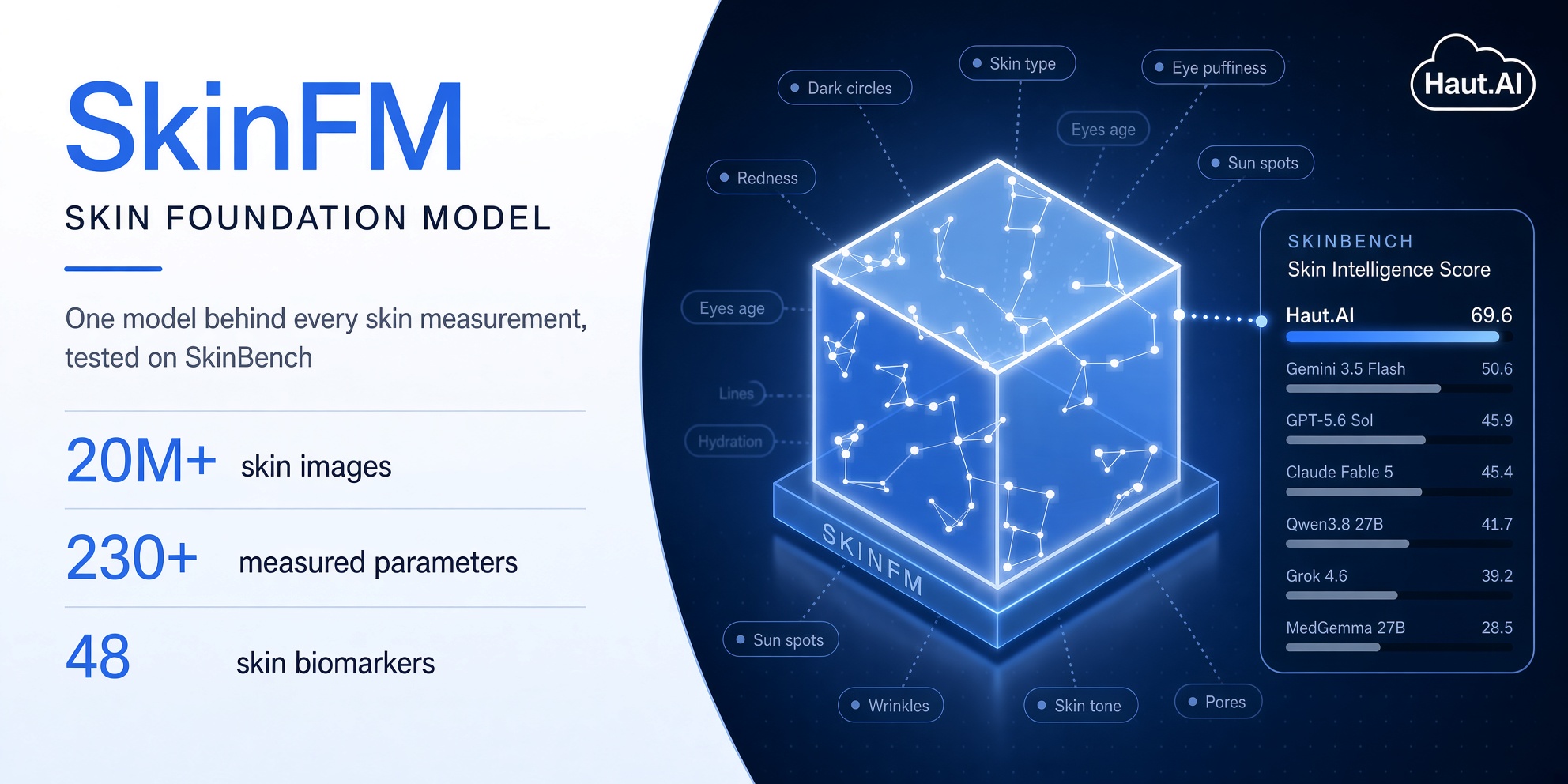
On October 27, 2026, Haut.AI released SkinBench alongside SkinFM, its Skin Foundation Model: a single, image-based AI model trained on more than 20 million skin images, real and synthetic, over 4 million of them real. This article explains what a skin foundation model is, what SkinBench found, and what beauty brands should check before they trust any AI with skin assessments and product recommendations.
Generative AI is now part of how people shop for beauty. NielsenIQ found that 49% of consumers have taken beauty product recommendations from GenAI, and Accenture found that 75% of beauty consumers are open to an AI-powered shopping experience. Haut.AI's survey of 1,238 U.S. women found that 62% are interested in or already use AI for skincare or bodycare advice.
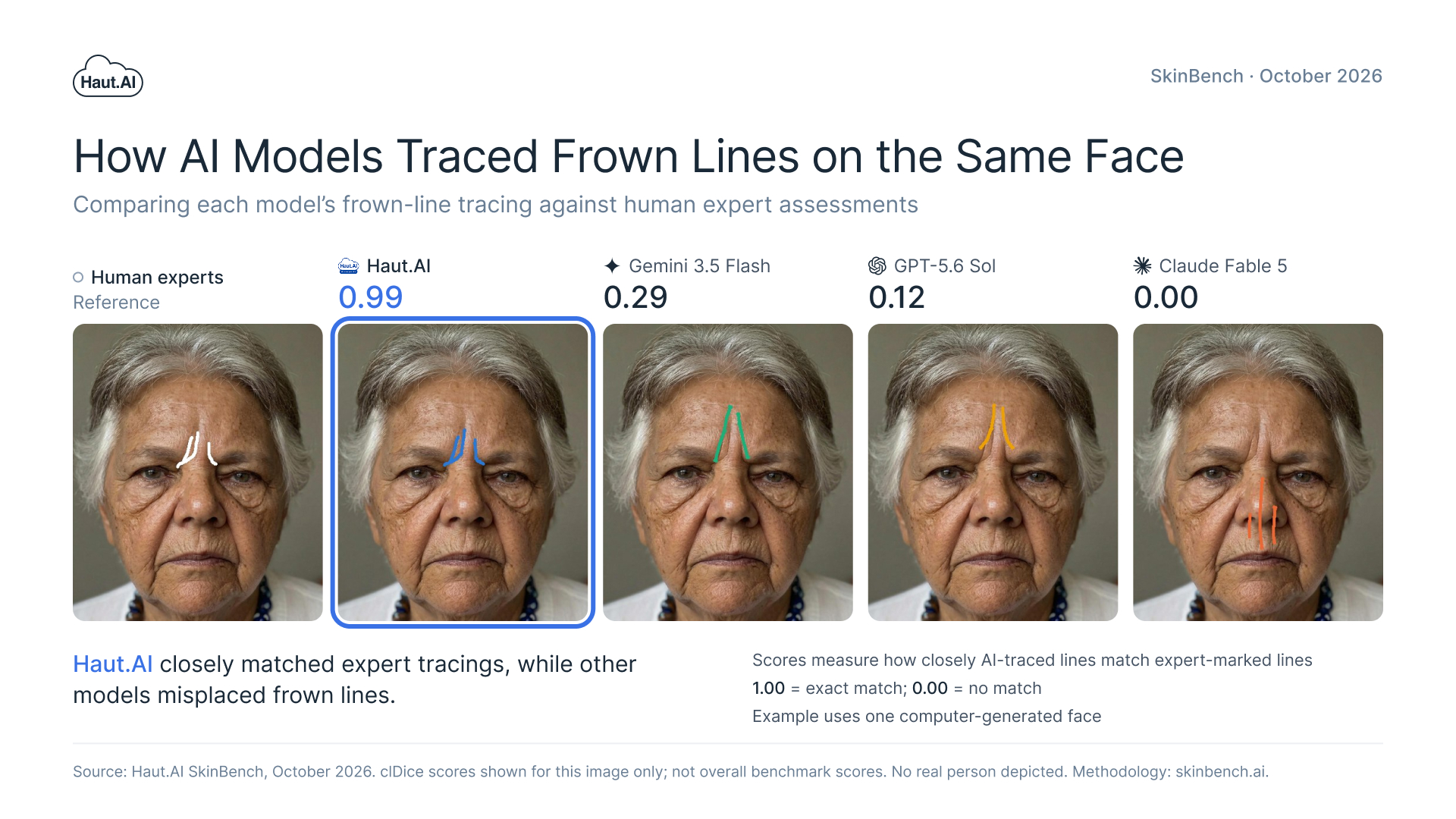
Much of that advice comes from general-purpose models. They are built to handle almost any question, and they will answer a question about skin with confidence. SkinBench suggests that confidence often runs ahead of accuracy. Beyond false detections, the models struggled to assess wrinkles and identify skin types. When asked to mark frown lines on a face, one leading model marked the nose and mouth instead, while another drew no lines on a test image.
For a beauty brand, each of those errors turns into a recommendation. A moisturizer chosen for the wrong skin type, or an eye cream for puffiness that is not there, costs the consumer money and costs the brand trust.
SkinFM is Haut.AI's Skin Foundation Model, built for image-based skin analysis.
Traditional AI systems require separate models for different skin analysis tasks. SkinFM replaces that setup with a single, image-based AI foundation that analyzes multiple skin characteristics. Because new measurements build on the same foundation, Haut.AI can develop them faster and create grading systems customized to an individual brand's needs.
SkinFM powers the Haut.AI technology scored in SkinBench. That technology can assess more than 230 skin measurements and 48 biomarkers, including wrinkles, redness, pigmentation and other visible skin characteristics.
For beauty brands, this means they can:
The approach reflects a wider shift in business AI. In April 2025, Gartner predicted that by 2027, businesses would use smaller, specialized AI models at least three times as often as general-purpose large language models.
SkinBench was developed by Haut.AI's Data Science team. It evaluates AI models across 19 tests covering seven common skin concerns and characteristics: wrinkles, sun spots, redness, skin tone, skin type, dark circles and eye puffiness. Eleven tests identify and grade visible skin features, and eight measure how accurately models locate those features. Results are compared against reference assessments prepared by experts. The leaderboard and scoring method are public at skinbench.ai.
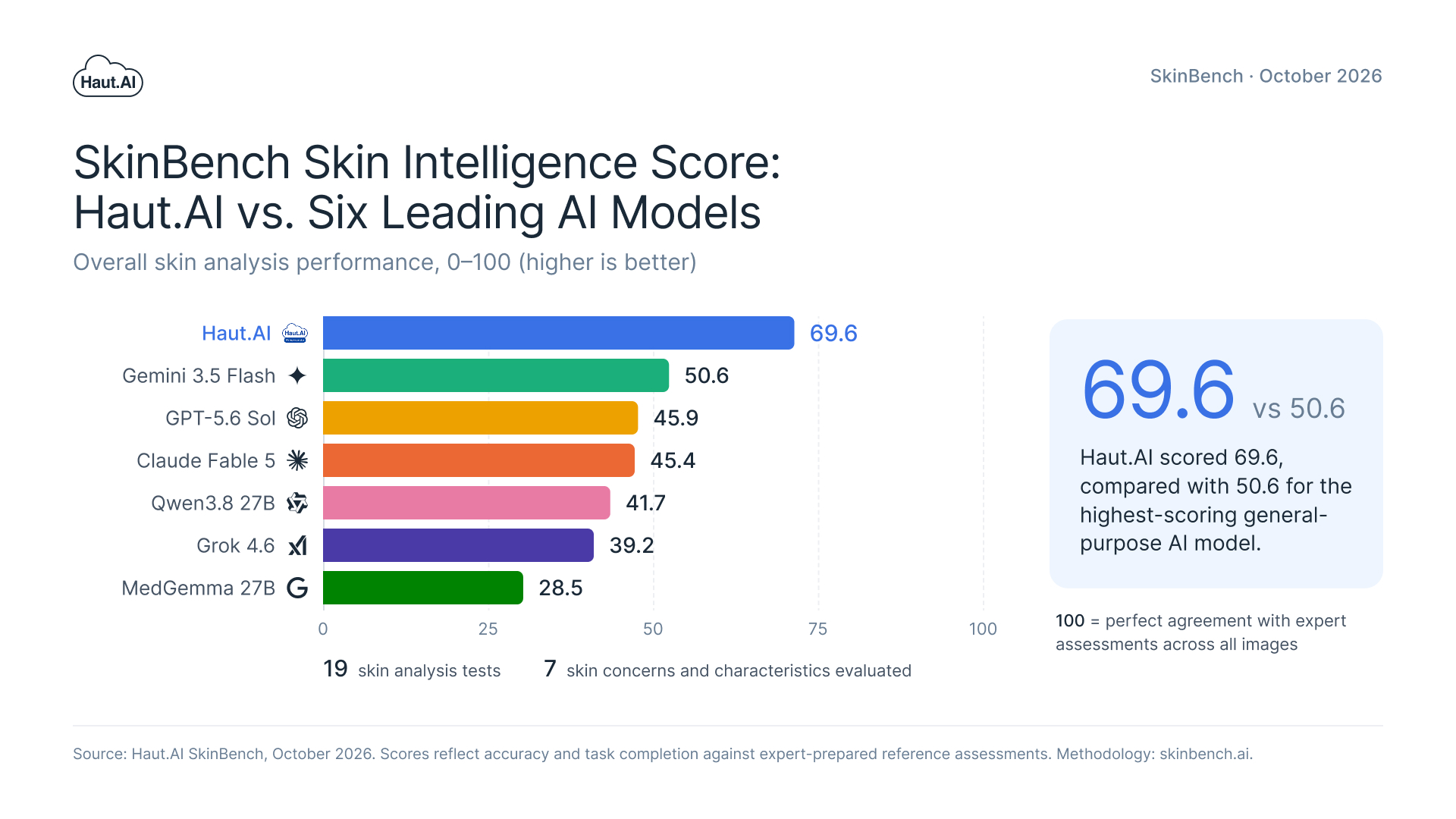
The first edition (October 2026) compares Haut.AI's technology with Gemini 3.5 Flash, GPT-5.6 Sol, Claude Fable 5, Grok 4.6, Qwen3.8 27B and MedGemma 27B. Haut.AI scored 69.6 out of 100 on the Skin Intelligence Score, the average of a model's results across the seven skin parameters. Full agreement with expert ground truth would be 100. Gemini 3.5 Flash, the highest-scoring general-purpose model, scored 50.6.
The individual tests show where the gap comes from:
Haut.AI did not lead every test. Other models scored higher on 2 of the 19 tasks, assessing skin tone and grading crow's feet, with Gemini 3.5 Flash leading both. That is why SkinBench reports separate scores for each skin parameter, not only one overall number.
"AI can recognize a face, but that doesn't mean it can accurately assess the skin," said Anastasia Georgievskaya, CEO & Co-Founder of Haut.AI. "Our findings show that some of today's leading AI models frequently detect skin problems that don't exist. That's a serious concern as consumers increasingly rely on AI for skincare advice. We developed SkinFM to make skin analysis more accurate and created SkinBench so the industry can see how different AI models actually perform."
AI skin analysis accuracy is not an abstract metric. It decides what a consumer is told to buy.
When AI reports a concern that is not there, the result is an unnecessary product recommendation, wasted spending and lower confidence in the brand's personalized skincare service. When it misreads skin type, recommendations for moisturizers, cleansers and other everyday products go wrong.
Location matters as much as detection. Brands need to know where wrinkles are to measure change and assess product results over time. The same principle of consistent, repeatable measurement sits behind large-scale clinical skin research.
Inclusivity matters too. A model that works well on average but poorly for one group of consumers will give that group weaker advice. Brands need to make sure their technology works reliably for consumers with different complexions.
"A false detection isn't just a technical mistake," said Anastasia Georgievskaya. "It can lead to inappropriate product recommendations, unnecessary purchases and a loss of consumer trust. Our goal is to give brands the evidence they need to choose AI technology that earns and maintains consumer trust."
A single overall score can hide weak spots. Before choosing AI for skin assessment, brands can ask four questions:
SkinBench's per-parameter scores help answer these questions.
Haut.AI plans to expand SkinBench with additional AI models and new tests that examine whether models produce consistent results when analyzing the same skin concerns.
See the leaderboard at skinbench.ai, or book a demo to see how Haut.AI's skin intelligence can be tailored to your products and customers.
SkinFM is Haut.AI's Skin Foundation Model, launched on October 27, 2026. It is an image-based AI foundation model trained on more than 20 million skin images, real and synthetic, over 4 million of them real. It powers the Haut.AI technology scored in SkinBench and lets Haut.AI develop new skin measurements and brand-customized grading systems faster.
SkinBench is a public benchmark, developed by Haut.AI's Data Science team, that compares AI models on skin analysis. Its first edition (October 2026) covers 19 tests across seven skin concerns and characteristics, with results compared against reference assessments prepared by experts. The leaderboard and scoring method are public at skinbench.ai.
In the first edition of SkinBench (October 2026), six leading AI models, including Gemini 3.5 Flash, GPT-5.6 Sol and Claude Fable 5, flagged eye puffiness in approximately 95% to 100% of images where it was absent. The highest-scoring general-purpose model, Gemini 3.5 Flash, scored 50.6 out of 100 on the Skin Intelligence Score, against 69.6 for Haut.AI.
No. Haut.AI scored highest overall, but other models scored higher on 2 of the 19 tasks, assessing skin tone and grading crow's feet, with Gemini 3.5 Flash leading both. SkinBench reports separate scores for each skin parameter, so brands can compare models on the tasks they need.
No. SkinBench evaluates image-based skin analysis tasks, such as grading wrinkles, classifying skin type and locating visible features. It does not evaluate medical diagnosis or clinical decision-making.